La liberalización del mercado regulado abrirá las puertas no solo para nuevos actores de esta industria, sino que la comercialización de energía podría resultar atractiva hasta para retailers y bancos, pese a que la experiencia internacional demuestra que los clientes residenciales, que en Chile representan la mitad del total de potenciales usuarios, son más bien reacios a cambiarse de proveedor.
Jessica Esturillo O.
Fuente: El Mercurio
Hace unas semanas el Ministerio de Energía se embarcó en la primera de las tres etapas que definió para llevar adelante una de las reformas más complejas de la regulación del sector energético: la modernización de la distribución eléctrica que, al ser la cara más visible para los consumidores finales, es por lejos el más sensible de los tres segmentos que conforman este negocio. El tema es tan delicado que al menos dos intentos anteriores de ajuste a esta normativa fracasaron.
Tras un largo análisis, la autoridad optó por iniciar este ajuste legal con la liberalización del mercado regulado mediante la creación de la figura del comercializador de electricidad, que se incorporará como un cuarto actor en la cadena de suministro junto a la generación transmisión y distribución. Esto implica que habrá empresas que estarán dedicadas solo a la venta minorista de energía para los casi 7 millones de clientes regulados, la mitad de cuales corresponden a usuarios residenciales.
«Las empresas deberán competir porque seamos sus clientes. Esto se traducirá en un mejor servicio y menores precios», dice el Ministerio de Energía. La estimación del ministro, Juan Carlos Jobet, es que si el 100% de los clientes regulados migrara a transformarse en un cliente «libre» el sistema tendría ahorros por US$ 800 millones, mientras que si solo lo hicieran los clientes residenciales – la otra mitad son pequeños comercios, industrias u oficinas-, aquella cifra se reduciría a la mitad. En términos de las cuentas individuales de luz, la estimación apunta a reducciones en promedio de 20%.
La figura de comercializador no es nueva, opera hace varios años, por ejemplo, en Europa, Estados Unidos y Latinoamérica. En algunos mercados ha dado buenos resultados, promoviendo la competencia y con ello precios de energía más bajos, mientras que en otros casos la experiencia ha sido menos alentadora.
El proyecto chileno plantea separar la operación de la infraestructura eléctrica -que quedaría en manos de las actuales distribuidoras-, de la venta de energía, que estaría en mano de estos comercializadores. El debate recién comienza y no será fácil.
1 ¿QUIÉN PODRÁ SER COMERCIALIZADOR? El proyecto plantea que para ser comercializador hay que construir una empresa con ese giro y con sede en Chile. También deberá demostrar una solvencia que garantice el suministro comprometido con los clientes.
Empresas del sector eléctrico -generadoras y las propias distribuidoras, a través de empresas independientes y con eventuales restricciones de operar en sus propias zonas de concesión-, son las primeras candidatas. Sin embargo, Cristián Muñoz, director de Breves de Energía, dice que este nuevo negocio es una buena oportunidad para empresas relacionadas con la energía, como distribuidoras de gas o de combustibles líquidos, que podrían ofrecer paquetes de energía.
También menciona a firmas del retail masivo porque tendrían la posibilidad de integrar beneficios y servicios y, en su opinión, tendrían mayor ventaja para desafiar a otros actores del rubro eléctrico que se constituyan como comercializadores, como generadoras o las propias distribuidoras actuales.
Sebastián Novoa, director ejecutivo de Ecom Energía, firma que presta servicios de comercialización de energía para clientes libres, comenta que en España, por ejemplo, la cadena de tiendas El Corte Inglés tuvo un paso por este negocio, mientras que algunos bancos están incursionando en Brasil y Colombia.
2 ¿ESTO ES UNA ALTERNATIVA PARA TODOS LOS CLIENTES? El proyecto de ley divide a los clientes en tres grupos: a los libres que tienen potencia superior a los 5.000 kW y negocian directamente con las generadoras; los medianos con potencias entre 21 kW y 5.000 kW, y los pequeños que son el grupo más numeroso y tienen potencia conectada de hasta 20 kW. Acá están los clientes residenciales, cuya potencia es de hasta 10 kW.
Los comercializadores podrán atender a estos dos últimos grupos y para ello requerirán licencias que otorgará la autoridad. Más allá de las expectativas del ministro Jobet, la experiencia internacional muestra que los niveles de migración de estos segmentos son más bien bajos. En España, a diciembre del 2018, la tasa de cambio de clientes domésticos fue de un 8% y la del segmento Pyme e industrial fue de 23% y 27%, respectivamente. En el Reino Unido, la tasa de cambio de los clientes residenciales entre 2013 y 2017 fue de 12,8% y en ese mismo período en Noruega fue de 15,9%, mientras en Italia llegó al 8%.
El director asociado de la consultora Systep y académico de la Universidad de Chile, Alejandro Navarro Espinoza, explica que la clave está en la sensibilidad de los usuarios al precio. «Si el residencial no ve una ganancia sustantiva que pague el esfuerzo de tiempo de cambiarse de comercializador probablemente no lo hará. Esto puede ser distinto en usuarios medianos y grandes donde el pago de electricidad puede ser una componente relevante de sus costos», plantea. Y añade que el interés por suministros específicos -como que sea 100% renovable- podría incentivar el cambio.
Por otra parte, para las comercializadoras no todas las zonas ni todos los clientes tienen el mismo atractivo comercial. Acá, dicen en el mercado, surge una observación al proyecto del Gobierno, pues este pretende habilitar la denominada portabilidad eléctrica en forma gradual a partir de ciudades, partiendo por aquellas más vulnerables en términos sociales o ambientales. Este modelo le restaría atractivo económico al sistema porque los costos de instalación comercial podrían ser mayores que los beneficios que podrían obtener.
Los privados plantean que sería más eficiente el modelo comenzando con los consumos de energía más altos para «formar el músculo» que permita abordar después los consumos más bajos, especialmente en zonas menos densas o más alejadas.
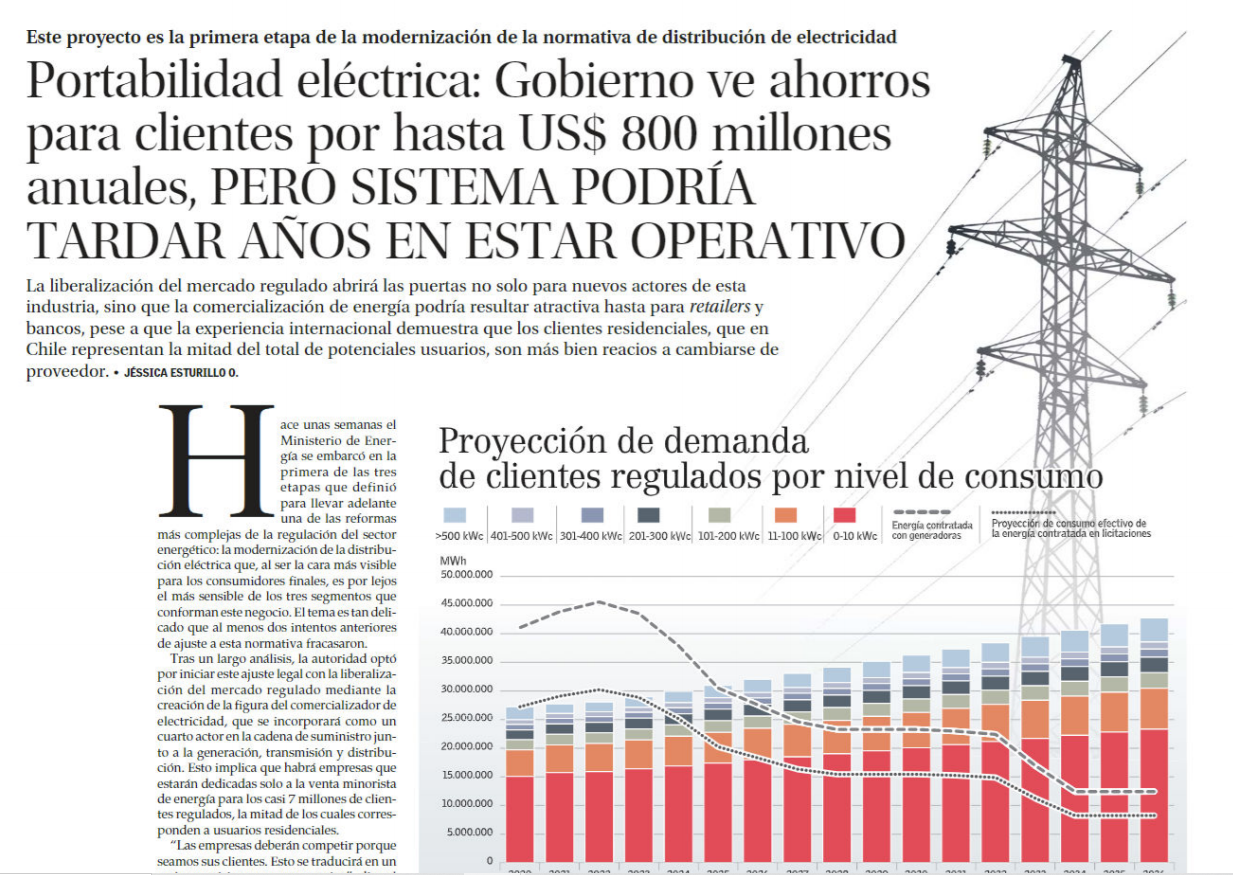
3 ¿CUÁNDO SERÁ POSIBLE CAMBIARSE? Acá no hay una sola opinión, pues mientras en el Gobierno aseguran que el sistema estará disponible un año después que el proyecto se apruebe, a juicio de especialistas la portabilidad recién podría partir hacia 2023, cuando la demanda de energía proyectada alcanzaría un nivel adecuado. Hoy en cambio, la demanda es baja y no cubre la energía ya contratada en el sistema regulado. Otras estimaciones apuntan a que dicho balance no se alcanzará antes de 2026 y con ello los clientes residenciales se incorporarían hacia 2032. Esto porque las estrategias de los comercializadores apuntarán a captar primero a los clientes medianos y después a los pequeños.
Claudio Seebach advirtió esta semana en el Congreso que «existe hoy una menor demanda de energía respecto de lo que fue adjudicado en las licitaciones realizadas por el Estado y por eso una reforma al segmento de la distribución tiene que buscar evitar un impacto en el equilibrio económico de esos contratos que son los que precisamente hacen posible esta transición energética de Chile», dijo.
4 ¿LA ENERGÍA SERÁ MÁS BARATA? Esta es la pregunta que tiene la respuesta más incierta. No existe claridad respecto de si las bajas que la autoridad ha anticipado responderán al efecto de la mayor competencia que se espera o realmente serán fruto de una baja natural producto del fin de contratos anteriores más caros y la entrada de otros más baratos, adjudicados en las últimas licitaciones de suministro.
Otro factor que influiría, dicen en la industria, es el congelamiento de los precios de la energía para evitar nuevas alzas en las cuentas de la luz, ya que este mecanismo considera que hasta 2027 los clientes regulados pagarán en forma adicional por la energía que ahora no se les está cobrando, incluso si migraron al sistema libre. Esto le restaría atractivo a la oferta de los comercializadores, figura que, a juicio de algunos analistas, solo vendría a poner una distorsión adicional a las incorporadas en los últimos doce meses para evitar nuevas alzas en las cuentas de la luz.
Navarro Espinoza dice que los beneficios tarifarios respecto del comercializador están más claros para los clientes medianos, y que respecto del segmento doméstico hay dudas porque es menos elástico al precio y, a la vez, por sus volúmenes de consumo sería menos atractivo para los comercializadores. «Con todo, la idea del comercializador es buena sobre todo en el sector no doméstico. En el sector doméstico, la autoridad tendrá que mostrar que los beneficios son mayores a los costos asociados, tratando siempre que dichos costos sean los menores posibles», puntualiza.