
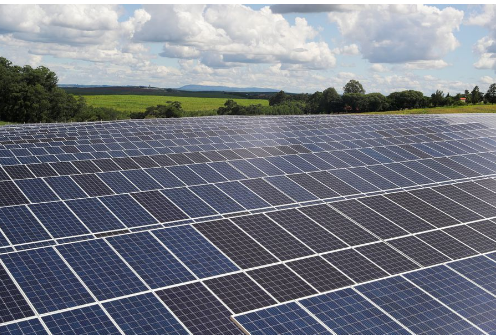
Renovables desplazarán por primera vez al carbón como principal fuente de energía a partir de este año

13 Mayo, 2021

Fuente: Pulso

Proyección del Coordinador Eléctrico supone que se cumpla con el plan de instalación de 2.450 MW de solar, más otros 1.540 MW de eólica. Así, la suma de estos energéticos, las hidro ERNC, la geotermia y otros, superarán el aporte del carbón.

El carbón como fuente de generación eléctrica en Chile tiene fecha de vencimiento. Y mientras eso llega, son las energías renovables las que están tomando la posta.

Tanto así que a partir de este año se espera que el aporte de las fuentes renovables no convencionales -es decir, eólica, solar, geotermia, hidro ERNC y bio ERNC- supere al del carbón, que a pesar del retiro de varias unidades debido al plan de descarbonización, mantiene un aporte superior al 30% de la matriz.

Esto, según datos del Coordinador Eléctrico, organismo encargado del despacho de las centrales eléctricas y de, como lo dice su nombre, coordinar la operación del sistema. Según la proyección 2021 de este organismo, el aporte de las unidades ya nombradas, agrupadas como ERNC, alcanzará el 35,5% del sistema, versus el carbón que aportará el 31,6%.

Esto, siempre y cuando se cumplan los compromisos de instalación de nuevas nunidades eólicas y solares por casi 4.000 MW anunciadas para este año, de las cuales 2.450 MW son solares y 1.540 MW eólicos.

Por tecnología, la generación solar -principalmente fotovoltaica, pero también termosolar, de la que ya se inauguró una central en el país, que a la vez es la primera de su tipo en Sudamérica- será la de mayor aporte de entre las ERNC, llegando al 17,7% de participación en el sistema, con una generación anual esperada de 13.880 GWh. Esto la instala en el tercer lugar como fuente individual de producción eléctrica, por debajo del ya mencionado carbón y también de la hidroelectricidad convencional, que si bien es considerada energía renovable, no es reconocida en Chile como ERNC.

El aporte de estas centrales hidro convencionales, entre las que se cuentan embalses de mayor tamaño, como Ralco, Pangue o Angostura, alcanzará este año el 24,4% del total del sistema.
Le sigue la producción eólica, que este año explicará el 11% del total de generación de electricidad, con 8.670 GWh esperados, en cuarto lugar y superando al gas natural, que alcanzará el 7,2%.

Estos importantes cambios se explican, principalmente, por la mayor competitividad que han alcanzado las fuentes renovables en relación a sus competidores. De hecho, las principales generadoras eléctricas del país como Colbún, Enel, AES Andes o Engie se han volcado a desarrollar nuevas iniciativas eólicas y solares y en el horizonte, con la excepción de Alto Maipo, en su última fase de construcción, no se vislumbran nuevas iniciativas convencionales como a gas, carbón o grandes hidroeléctricas.
Nueva capacidad

Este mayor aporte ERNC se sustenta en la entrada de nuevas centrales. De acuerdo con el informe de abril de la consultora Systep, en los siguientes 12 meses se espera la entrada en operación de 5.939 MW de nueva capacidad, de los cuales 3.027 MW son solares, 1.779 MW son eólicos, 28 MW son geotérmicos, 563 MW hidráulicos y 541 MW térmicos. Por contrapartida, se considera el retiro de Ventanas II, de AES Andes -es AES Gener- para julio 2021, equivalente a 193,5 MW.

De hecho, ya en marzo de 2021 había un total de 142 proyectos ERNC declarados en construcción, con entrada en operaciones hasta febrero de 2023. A esto se suma que en ese mes el Servicio de Evaluación Ambiental dio inicio a la tramitación de 47 nuevas iniciativas, que equivalen a 2.903 MW adicionales a los declarados en construcción, con una inversión asociada de 4.395,8 MW. Además, se otorgó la RCA a iniciativas que suman otros 785 MW, equivalentes a 829,7 MW.

“Nos parece muy positivo que la penetración de Energías Renovables No Convencionales (ERNC) esté resultando sostenidamente superior a los objetivos que se planteaban en la discusión de la ley. En ese entonces se pensaba en una meta de 20% al año 2025 y particularmente 13,5% al 2021. Esto sin duda confirma que el objetivo de descarbonización al 2040 puede lograrse, considerando que más del 90% de los nuevos proyectos de generación ingresados en el Servicio de Evaluación Ambiental corresponden a proyectos fotovoltaicos y eólicos, y una generación total de ERNC de 22,2% en el año 2020?, destaca Pablo Demarco, gerente comercial de Plataforma Energía.

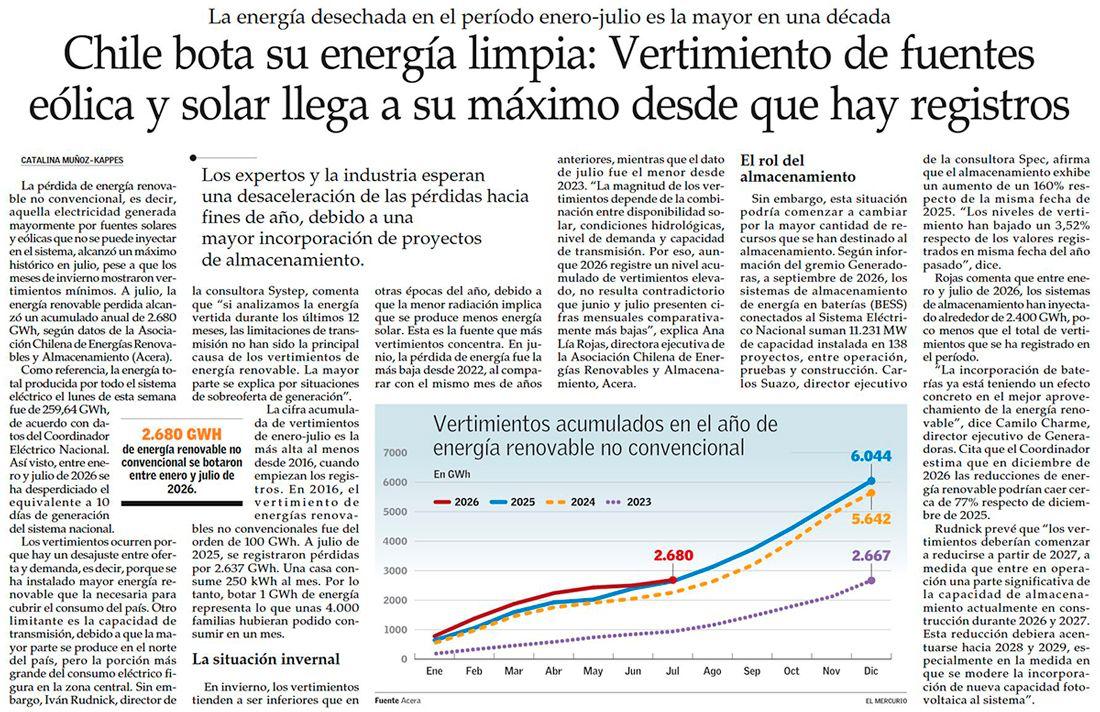
Source: Pulse

The Electricity Coordinator’s projection assumes that the plan to install 2,450 MW of solar, plus another 1,540 MW of wind power, will be met. Thus, the sum of these energy sources, hydro NCRE, geothermal and others, will exceed the contribution of coal.

Coal as a source of electricity generation in Chile has an expiration date. And while that is coming, it is renewable energies that are taking over.

So much so that, as of this year, it is expected that the contribution of non-conventional renewable sources – i.e. wind, solar, geothermal, hydro NCRE and bio NCRE – exceeds that of coal.Despite the retirement of several units due to the decarbonization plan, it maintains a contribution of more than 30% of the matrix.

This, according to data from the Electricity Coordinator, the body in charge of dispatching power plants and, as its name implies, coordinating the operation of the system. According to the 2021 projection of this organization, the contribution of the aforementioned units, grouped as NCRE, will reach 35.5% of the system, compared to coal, which will contribute 31.6%.

This is provided that the commitments to install almost 4,000 MW of new wind and solar units announced for this year, of which 2,450 MW are solar and 1,540 MW are wind, are met.

By technology, solar generation -mainly photovoltaic, but also solar thermal, of which one plant has already been inaugurated in the country, the first of its kind in South America- will be the largest contributor among NCRE, reaching a 17.7% share in the system, with an expected annual generation of 13,880 GWh. This places it in third place as an individual source of electricity production, below the aforementioned coal and also conventional hydroelectricity, which, although considered renewable energy, is not recognized in Chile as NCRE.

The contribution of these conventional hydroelectric plants, which include larger reservoirs such as Ralco, Pangue or Angostura, will reach 24.4% of the system’s total this year.
It is followed by wind production, which will account for 11% of total electricity generation this year, with 8,670 GWh expected, in fourth place and surpassing natural gas, which will account for 7.2%.

These important changes are mainly explained by the increased competitiveness of renewable sources in relation to their competitors. In fact, the country’s main power generators such as Colbún, Enel, AES Andes or Engie have focused on developing new wind and solar initiatives and, with the exception of Alto Maipo, in its last phase of construction, no new conventional initiatives such as gas, coal or large hydroelectric plants are on the horizon.
New capacity

This increased NCRE contribution is supported by the entry of new power plants. According to the April report from the consulting firm SystepIn the next 12 months, 5,939 MW of new capacity is expected to come on line, of which 3,027 MW are solar, 1,779 MW are wind, 28 MW are geothermal, 563 MW are hydro and 541 MW are thermal. On the other hand, the retirement of AES Andes’ Ventanas II -that is AES Gener- is considered for July 2021, equivalent to 193.5 MW.

In fact, as of March 2021, there were a total of 142 NCRE projects declared under construction, with operations to start in February 2023. In addition, in that month, the Environmental Evaluation Service began processing 47 new initiatives, equivalent to 2,903 MW in addition to those declared under construction, with an associated investment of 4,395.8 MW. In addition, the RCA was granted to initiatives totaling another 785 MW, equivalent to 829.7 MW.

“We think it is very positive that the penetration of Non-Conventional Renewable Energies (NCRE) is turning out to be sustainably higher than the objectives set out in the discussion of the law. At that time, the goal was 20% by 2025 and particularly 13.5% by 2021. This undoubtedly confirms that the goal of decarbonization by 2040 can be achieved, considering that more than 90% of the new generation projects submitted to the Environmental Evaluation Service correspond to photovoltaic and wind projects, and a total NCRE generation of 22.2% in 2020,” says Pablo Demarco, commercial manager of Plataforma Energía.

Go to Top