
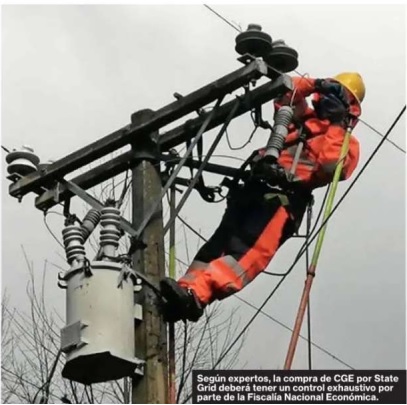
Con compra de CGE, china State Grid tendría casi 60% de la distribución eléctrica de Chile

13 Noviembre, 2020

Esta mañana, la española Naturgy anunció el traspaso de la distribuidora chilena a la firma asiática por US$3.000 millones

Por S. Sáez, C. Rivas e I. Badal

Fuente: La Segunda, Viernes 13 de Noviembre de 2020

China State Grid International Development Limited (SGID) se convertirá, si las autoridades chilenas lo permiten, en el actor más fuerte de la distribución eléctrica en nuestro país.

La empresa china, que había cerrado la adquisición de Chilquinta Energía y Luz Linares en US$2.230 millones a mediados de octubre del año pasado, ahora anunció la compra del 96% de la Compañía General de Electricidad (CGE) en 2.570 millones de euros (unos US$3 mil millones) a la española Naturgy (cuyo asesor financiero fue Banchile Citi).

El anuncio remeció a la bolsa de Madrid, donde las acciones de Naturgy se dispararon más de 6%. En el mercado chileno, los papeles de CGE que aún se transan (equivalentes a cerca del 4% de su propiedad) saltaron en la apertura más de 162% a $1.099, pero fueron suspendidos 40 minutos después.

De acuerdo al hecho esencial de Naturgy en España, la transacción supone valorar el 100% de CGE en términos “Enterprise value” (valor total de los activos de una empresa) de 4.312 millones de euros (US$5 mil millones).

“Debe mirarse con cuidado”

CGE cuenta hoy con 3.1 millones de clientes y un 44% de participación en el mercado nacional, lo que por sí sola la convierte en la mayor distribuidora del país, por sobre Enel Distribución (exChilectra), que sólo opera en el Gran Santiago y pose 1,9 millones de clientes, con un 27% de participación. Si se le suma Chilquinta y Luz Linares, que cuentan con 890 mil empalmes, o un 11,5% del mercado, la china State Grid pasaría a contar con casi 4 millones de clientes y 56% de toda la distribución eléctrica del país, y prácticamente este mercado quedaría en manos de dos grandes actores: State Grid y Enel. Mucho más abajo se ubica el Grupo Saesa, que atiende a 528 mil clientes (al cierre de 2019) y distribuidoras locales.

El ministro de Energía, Juan Carlos Jobet, advirtió que esta operación deberá ser revisada por la Fiscalía Nacional Económica (FNE).

“Las empresas deben someterse al procedimiento de control de operaciones de concentración ante la FNE, que puede aprobar la operación, aprobarla con condiciones o rechazarla, a partir del análisis sustantivo sobre sus efectos en la competencia”, explicó Fernando Araya, abogado de libre competencia del estudio Lewin.

“La FNE deberá observar con mucho cuidado esta operación, pues excede indudablemente los umbrales para requerir un control preventivo de concentración, más aún tomando en cuenta que se trata de distribución eléctrica, un mercado que es un monopolio natural regulado”, dijo el abogado Tomás Menchaca, expresidente del Tribunal de Libre Competencia.

Desafíos y sinergias

El nuevo controlador de CGE tiene por delante varios desafíos. “El más importante es cómo hacer conversar las operaciones de CGE con Chilquinta para aprovechar sinergias, abaratar costos y mejorar servicios”, cree Rodrigo Jiménez, gerente general de la consultora Systep.

En calidad de servicio, CGE está bastante abajo en el ranking anual de la Superintendencia de Electricidad (SEC). En 2019 figuró 21° entre 25 compañías, aunque en los primeros lugares había cooperativas o empresas pequeñas. En el ranking, que incluye notas en cortes de suministro, percepción de clientes y reclamos, CGE tuvo 1,07, 8,35 y 7,052 en escala de 1 a 10, respectivamente.

La adquisición de CGE se realizó en España, por tanto surge la duda respecto a donde se pagan los impuestos. Según el director internacional Tax & Legal de BDO, Mauricio Benítez, existe una fórmula para definirlo. “China va a comprar a España, sin embargo es una operación transfronteriza y el activo está en Chile. Por eso, se debe definir cuanto pesa CGE para Naturgy, y si es más del 20% del patrimonio de la española, los impuestos se deben pagar en Chile”, asegura.

This morning, Spain’s Naturgy announced the transfer of the Chilean distributor to the Asian firm for US$3 billion.

By S. Sáez, C. Rivas and I. Badal

Source: La Segunda, Friday, November 13, 2020

China State Grid International Development Limited (SGID) will become, if the Chilean authorities allow it, the strongest player in electricity distribution in our country.

The Chinese company, which had closed the acquisition of Chilquinta Energía and Luz Linares for US$2.23 billion in mid-October last year, now announced the purchase of 96% of Compañía General de Electricidad (CGE) for 2.57 billion euros (some US$3 billion) from Spain’s Naturgy (whose financial advisor was Banchile Citi).

The announcement rocked the Madrid stock market, where Naturgy shares soared more than 6%. In the Chilean market, CGE’s shares that are still traded (equivalent to about 4% of its ownership) jumped more than 162% to $1,099 at the opening, but were suspended 40 minutes later.

According to Naturgy’s essential fact in Spain, the transaction involves valuing 100% of CGE in terms of “Enterprise value” (total value of a company’s assets) of 4,312 million euros (US$5 billion).

“It should be looked at with care.”

CGE currently has 3.1 million customers and a 44% share of the national market, which alone makes it the largest distributor in the country, ahead of Enel Distribución (ex-Chilectra), which only operates in Greater Santiago and has 1.9 million customers, with a 27% share. If Chilquinta and Luz Linares, which have 890 thousand connections, or 11.5% of the market, are added, the Chinese State Grid would have almost 4 million customers and 56% of all electricity distribution in the country, and practically this market would be in the hands of two large players: State Grid and Enel. Much lower is the Saesa Group, which serves 528 thousand customers (at the end of 2019) and local distributors.

The Minister of Energy, Juan Carlos Jobet, warned that this operation will have to be reviewed by the National Economic Prosecutor’s Office (FNE).

“The companies must submit to the merger control procedure before the FNE, which can approve the operation, approve it with conditions or reject it, based on the substantive analysis of its effects on competition,” explained Fernando Araya, antitrust lawyer of the Lewin law firm.

“The FNE will have to observe this operation very carefully, as it undoubtedly exceeds the thresholds for requiring a preventive control of concentration, especially taking into account that it involves electricity distribution, a market that is a regulated natural monopoly,” said lawyer Tomás Menchaca, former president of the Tribunal de Libre Competencia (Court of Free Competition).

Challenges and synergies

CGE’s new controller faces several challenges. “The most important is how to make CGE’s operations talk to Chilquinta to take advantage of synergies, reduce costs and improve services,” believes Rodrigo Jiménez, general manager of the consulting firm Systep.

In quality of service, CGE is quite low in the annual ranking of the Superintendency of Electricity (SEC). In 2019 it ranked 21st out of 25 companies, although the top places included cooperatives or small companies. In the ranking, which includes scores for outages, customer perception and complaints, CGE had 1.07, 8.35 and 7.052 on a scale of 1 to 10, respectively.

The acquisition of CGE was made in Spain, so the question arises as to where the taxes are paid. According to BDO’s International Tax & Legal Director, Mauricio Benítez, there is a formula to define it. “China is going to buy from Spain, but it is a cross-border operation and the asset is in Chile. Therefore, it must be defined how much CGE weighs for Naturgy, and if it is more than 20% of the Spanish company’s assets, taxes must be paid in Chile,” he says.

Go to Top